
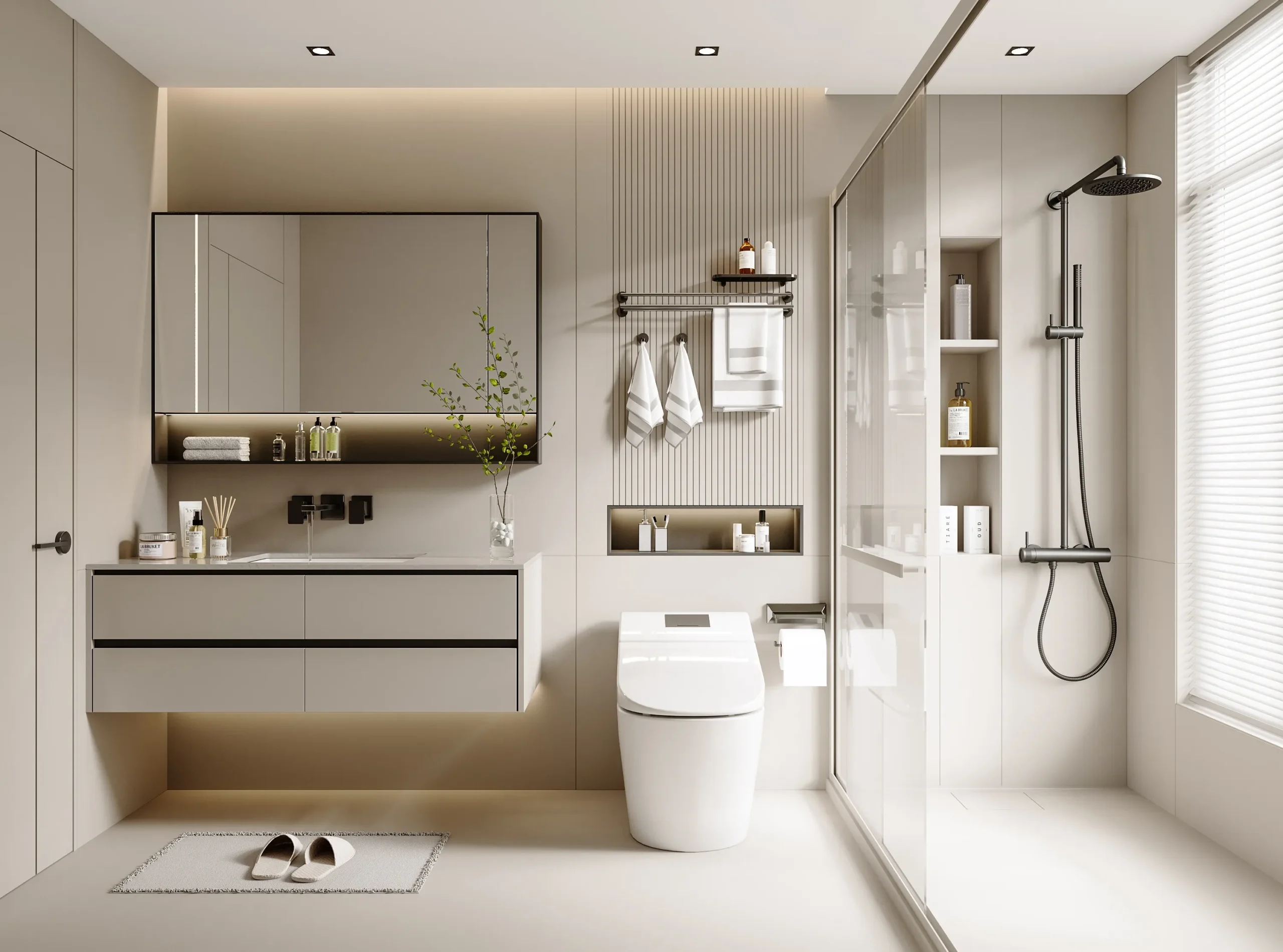
Choosing a bathroom vanity for a project is not only about appearance.
For B2B buyers, the cabinet needs to match the bathroom layout, storage requirements, material specifications, hardware configuration, and overall project budget. When ordering custom bathroom vanities, small differences in construction and configuration can also affect production and installation.
An aluminum bathroom vanity can be customized in many different ways, but buyers should understand the product structure before placing an order.
Here are some of the main points worth checking.
1. Check the Actual Cabinet Structure1.
The first thing to check is what the cabinet is actually made of.
The term “aluminum bathroom vanity” can refer to different constructions on the market. Some products use aluminum components, while others may use aluminum-faced composite boards or other materials.
For buyers looking for a full aluminum cabinet, it is useful to ask the supplier about the actual panel structure, including:
- Aluminum sheet thickness
- Core material
- Panel thickness
- Connection method
- Edge treatment
- Internal reinforcement
For example, an aluminum honeycomb panel can consist of aluminum skins combined with an aluminum honeycomb core.
The product name alone does not always tell you the complete construction, so asking for a cross-section or material specification can be more useful than simply asking whether the cabinet is “aluminum.”
2. Confirm the Dimensions Before Production
Bathroom space varies from project to project.
Common vanity widths may include 600 mm, 800 mm, 900 mm, 1000 mm, and 1200 mm, but custom dimensions are often required for project orders.
Before production, buyers should confirm:
- Overall width
- Cabinet depth
- Cabinet height
- Wall-mounted or floor-standing design
- Basin dimensions
- Countertop dimensions
- Drainage position
- Water supply position
A few centimeters can make a difference when the vanity needs to fit between walls or work with existing plumbing.
For this reason, dimension confirmation should be completed before production rather than adjusted after the cabinets arrive.
3. Consider the Bathroom Environment
Bathrooms are different from bedrooms, living rooms, and other areas of the home.
Water, humidity, steam, cleaning products, and daily use all place different demands on furniture.
This is one reason aluminum is used for bathroom furniture.
An aluminum-based cabinet structure does not have the same moisture-related concerns as conventional wood-based cabinet materials. However, the cabinet should still be properly designed and assembled.
Edges, joints, hardware, surface finishes, and installation all matter.
A moisture-resistant material alone does not automatically make an entire vanity waterproof.
4. Choose the Surface Finish
The cabinet structure is only one part of the product. The surface finish also affects the final appearance.
Depending on the product and project requirements, aluminum bathroom vanities can be produced with different surface effects, including solid colors and wood-look finishes.
Common options can include:
- PVC film wrapping
- Powder coating
- Wood-grain finishes
- Stone-look finishes
- Fabric-look finishes
For projects with multiple bathrooms, buyers may also want to confirm whether the same finish can be maintained consistently across different production batches.
A finish sample or physical color sample is therefore useful before mass production.
5. Check the Hardware Configuration
Hardware is another detail that should be confirmed before ordering.
Different projects may require different drawer slides, hinges, handles, and opening configurations.
For example, a vanity for a residential project may have different storage requirements from one designed for a hotel or apartment development.
Buyers should confirm:
- Drawer slide brand and model
- Hinge configuration
- Handle style
- Soft-close function
- Drawer quantity
- Door configuration
- Hardware upgrade options
It is better to specify these details before production than to treat them as an afterthought.
6. Check the Countertop and Basin Configuration
The cabinet and countertop should be considered as one complete installation system.
The countertop needs to match the cabinet width and depth, while the basin needs to match the countertop and cabinet configuration.
Depending on the project, buyers may choose different basin types and countertop materials.
Before production, confirm:
- Basin type
- Basin dimensions
- Countertop material
- Countertop thickness
- Faucet position
- Drain position
- Backsplash requirements
For larger projects, confirming these details in advance can reduce installation problems later.
7. Ask About Customization
One of the main reasons B2B buyers work directly with manufacturers is the ability to customize the product.
A standard retail vanity may have a fixed size and configuration. A project supplier, however, may need several sizes or different configurations within the same product series.
Customization may include:
- Cabinet dimensions
- Door and drawer layouts
- Surface finishes
- Hardware
- Basin and countertop configuration
- Wall-mounted or floor-standing installation
- Packaging
- Project-specific requirements
This is particularly useful for developers, contractors, furniture brands, distributors, and other buyers purchasing multiple units.
8. Don’t Look at Price Alone
Price is obviously important for a B2B project, but comparing only the final quotation can make different products appear more similar than they actually are.
Two bathroom vanities may have the same external dimensions while using different panel structures, hardware, finishes, or internal construction.
When comparing quotations, it is useful to compare the complete specification:
Material + panel structure + dimensions + hardware + finish + countertop/basin + packaging + quantity
This gives buyers a clearer picture of what is actually included in the price.
A Bathroom Vanity Should Be Evaluated as a Complete Product
An aluminum bathroom vanity is more than an aluminum cabinet.
The final product combines the cabinet structure, surface finish, hardware, countertop, basin, dimensions, and installation requirements.
For B2B buyers, the most important step is therefore to confirm the complete specification before production.
Instead of asking only:
“How much is an aluminum bathroom vanity?”
It is more useful to provide the supplier with the required dimensions, quantity, configuration, finish, hardware, and project requirements.
This allows the supplier to provide a quotation based on the actual product rather than a basic cabinet price.
Custom Aluminum Bathroom Vanities for B2B Projects
Makorohome provides customizable aluminum furniture for B2B projects, including bathroom vanities, kitchen cabinets, and wardrobes.
Bathroom vanity specifications can be adjusted according to project requirements, including cabinet dimensions, configuration, surface finish, hardware, countertop and basin matching.
If you are sourcing bathroom vanities for a residential development, hotel, apartment project, furniture brand, or distribution business, you can contact us with your required dimensions and specifications.
We can discuss the cabinet structure, configuration, finishes, and production requirements based on your project.